Learning Environments Action Research Network (LEARN)
Follow Our Social:

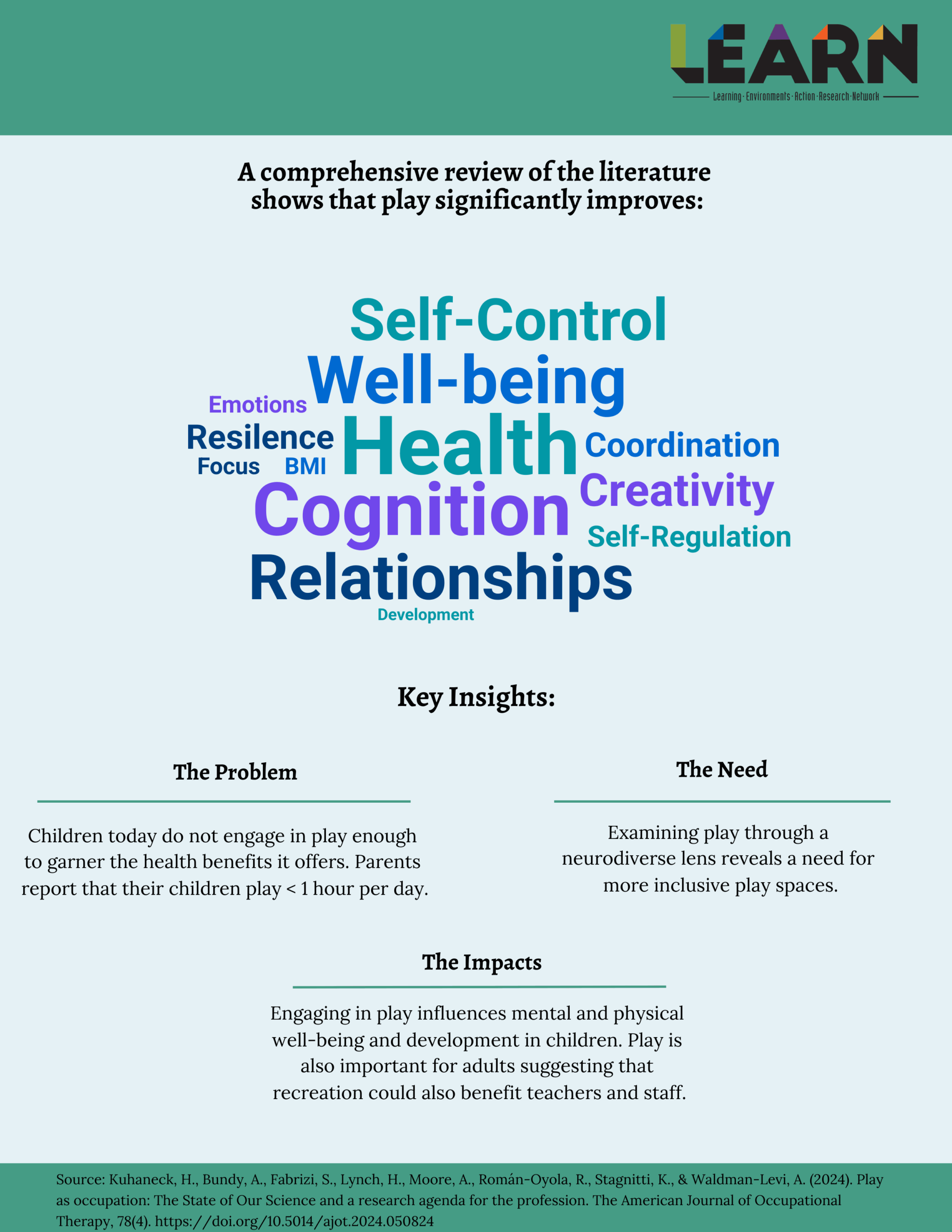
Source: Heather Kuhaneck, Anita Bundy, Sarah Fabrizi, Helen Lynch, Alice Moore, Rosa Román-Oyola, Karen Stagnitti, Amiya Waldman-Levi; Play as Occupation: The State of Our Science and a Research Agenda for the Profession. Am J Occup Ther July/August 2024, Vol. 78(4), 7804185150. doi: https://doi.org/10.5014/ajot.2024.050824
LEARN Brief and Infographic Credits: Dr. Adanays Aranda, Dr. Jeannie Haubert, Ashlea Sovetts
Overview:
The authors explain that occupational therapists -with the backing of The United Nations Convention on the Rights of the Child- view play as a human right. They provide a strong review of literature examining the role of play as a powerful component of not just occupational therapy, but of the human life experience. In suggesting that play also benefits adults, the article hints at strategies for addressing teacher and staff wellness in addition to benefits to students. The article identifies important gaps between knowledge and practice, particularly in serving neurodiverse students. Exploring innovative ways to incorporate play into the school day supports LEARN’s key organizational pillars, particularly health and access.
Key Insights:
Action Steps: