Learning Environments Action Research Network (LEARN)
Follow Our Social:

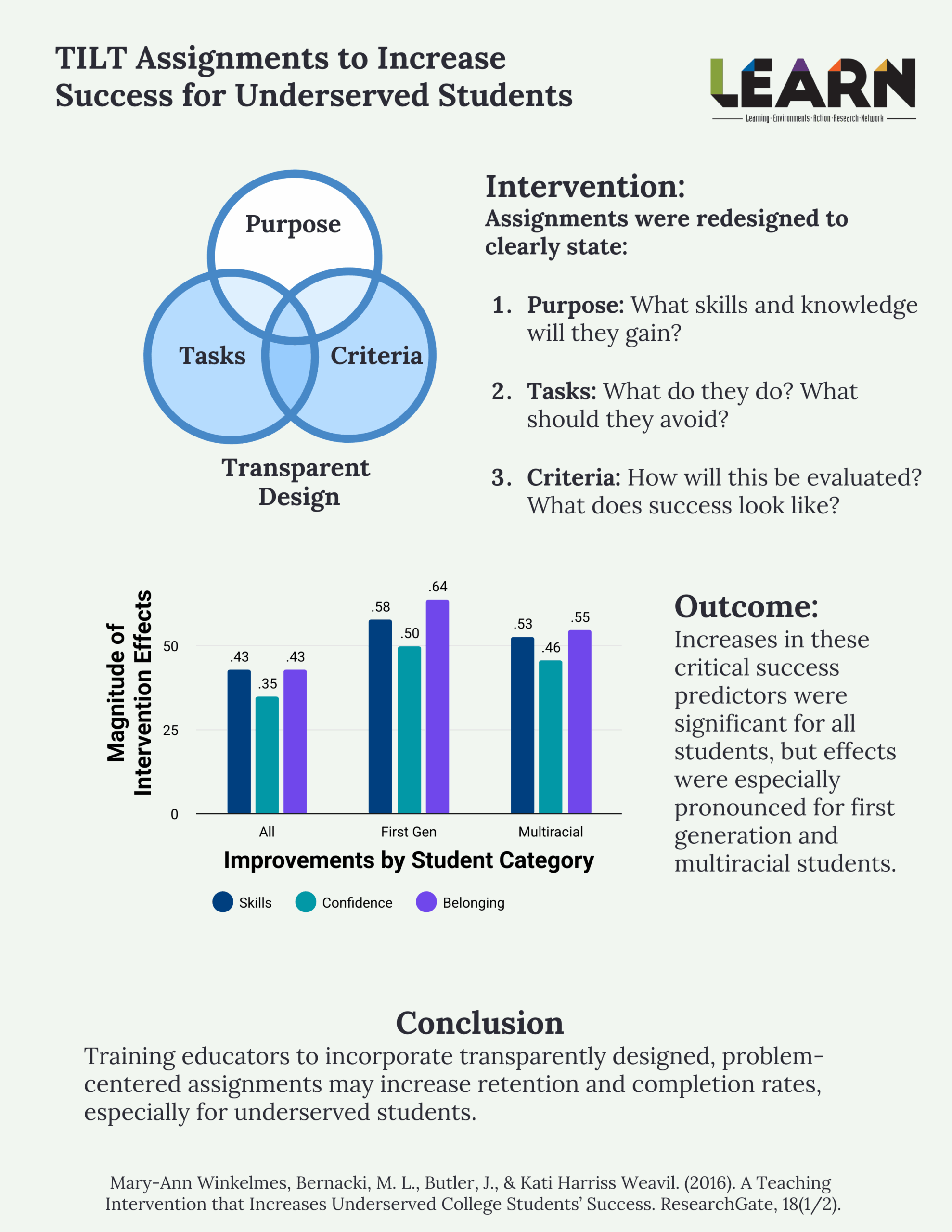
Source: Winkelmes, Mary-Ann & Bernacki, Matthew & Butler, Jeffrey & Zochowski, Michelle & Golanics, Jennifer & Weavil, Kati. (2016). A Teaching Intervention that Increases Underserved College Students’ Success. 18.
LEARN Brief and Infographic Credits: Dr. Dawson Orr, Dr. Jeannie Haubert, Ashlea Sovetts, MFA
Overview:
This study, which examined over 1800 students across seven higher education institutions that serve minority and underserved student populations, is applicable to K-12 learning environments. Transparent teaching design emphasizes sharing with students both how and why students are learning course content in particular ways. Educators in this research study were asked to take two assignments and “TILT” them or to revise their assignments to be both more transparent and problem centered. Three aspects are considered key to transparent design: sharing with students the purpose of the assignment, the tasks associated with the assignment, and the criteria for evaluating the assignment. Sharing the “purpose” of the assignment involved making students aware of what skills were to be practiced and what type of knowledge was to be gained. Sharing “tasks” with students is defined as discussing what they will do, including what steps to avoid or follow. Finally, the “TILT” method suggests that not only should students be made aware of what criteria will be used to evaluate an assignment, but that they should receive multiple examples of work that is considered high-quality. Providing examples helps to reduce the gap between the educator’s prompt and the student’s potential interpretation of that prompt. These small adjustments to assignments had a large impact, and were statistically significant in improving students’ academic confidence, sense of belonging, and metacognition, particularly around feeling that they were mastering skills that future employers may value. A final and significant aspect of this study was that while designing more transparent and problem-centered assignments positively affected all students, it had even higher benefits for minority and underserved students. Ultimately, the “TILT” design method both promoted equity for underserved students and had statistically significant benefits for all students.
Key Insights:
Unleash the power of ‘Transparent Teaching Design’ in your K-12 classroom by scoping out this exciting study, which transformed over 1800 students’ educational experience across seven institutions. By employing the “TILT” method—clarifying assignment purpose, tasks, and evaluation criteria—educators can substantially boost academic confidence, sense of belonging, and metacognitive skills. The results were even more profound for underserved students, demonstrating the potential of ‘TILT’ to drive equity and enhance learning outcomes for all students.
Action Steps: