Learning Environments Action Research Network (L.E.A.R.N.)
Follow Our Social:

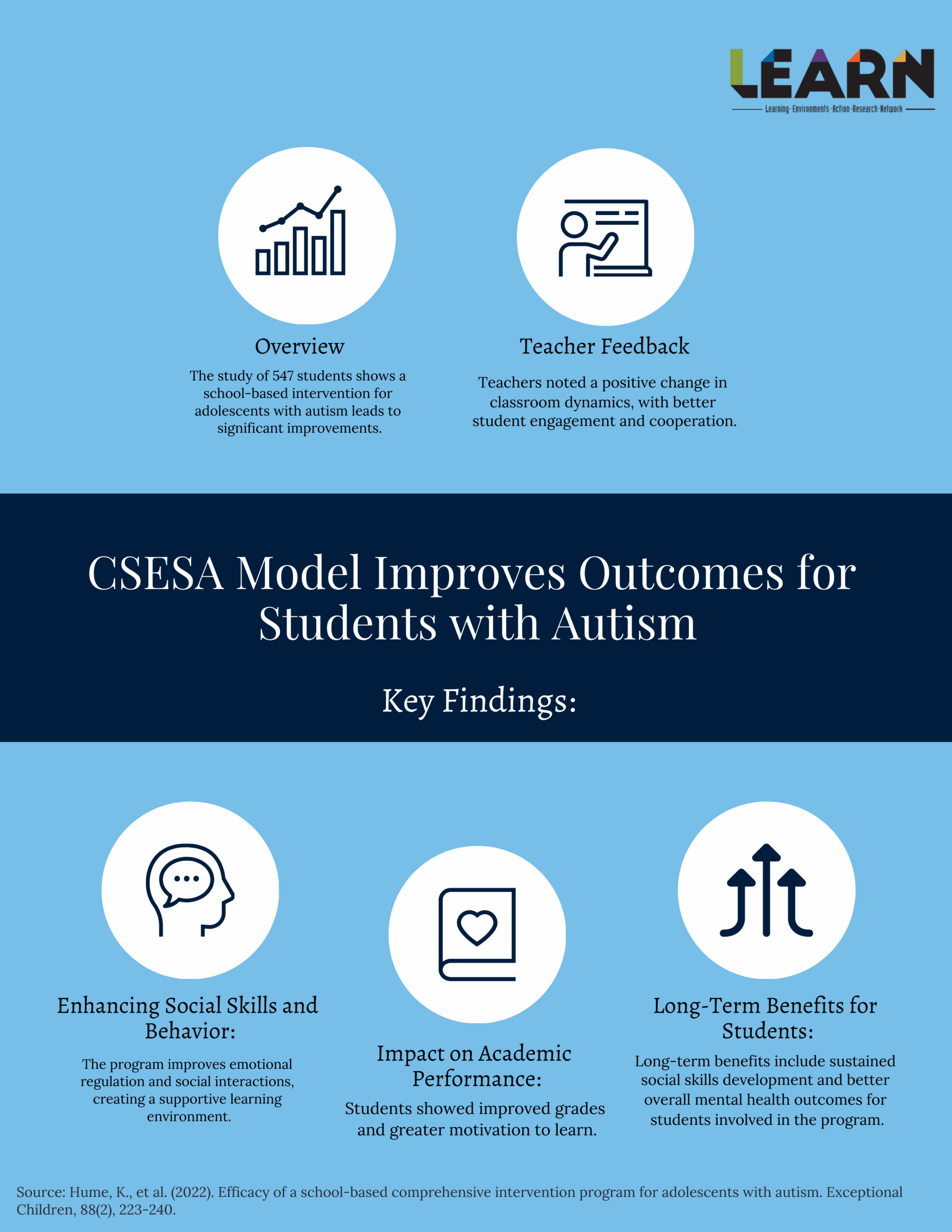
Hume, K., et al. (2022). Efficacy of a school-based comprehensive intervention program for adolescents with autism. Exceptional Children, 88(2), 223-240.
Key Takeaway: This engaging study funded by the USDE introduces a research supported model for autism programming for high school students and is a gateway to The Center on Secondary Education for Students with Autism Spectrum Disorder (CSESA) and a wealth of resources and materials. The findings are actionable.
Criteria: A large, randomized control study with 60 high schools in three states, supported by the National Center for Special Education Research and the Institute of Education Sciences.
Title and Authors: Hume, K., et al. (2022). Efficacy of a school-based comprehensive intervention program for adolescents with autism. Exceptional Children, 88(2), 223-240.
Resource: Link
Summation and Insights: As noted by the authors public education has struggled to meet the needs of adolescents and young adults and note the challenges and poorer outcomes they experience. In fact, at the time of the study, the researchers found no published studies of comprehensive programs for this population. CSESA, a multi-site research and development center, was charged with developing such a program and establishing its efficacy.
A comprehensive program
The research investigators noted the need for a comprehensive program that addressed the wide range of abilities and needs, general and special education status, different diploma plans, etc. Drawing on the research literature, the research team identified four high need domains for secondary students with autism: 1) academics, 2) peer relationships and social competence, 3) independence and behaviors, and 4) transitions and families and then developed a comprehensive model to address those needs.
What were the research questions?
The researchers compared overall program environment quality, student acquisition of their individualized educational goals, outcomes on standardized student performance measures, and positive effects for families.
The CSESA Model and program delivery
The study took place in 60 high schools across North Carolina, Wisconsin, and California over a two year period. The study compared the efficacy of their new model to the Services as Usual (SAU) model in the schools. The model delivery as described by the researchers consisted of a) establishing a heterogenous autism team, b) assessing program quality and student skills using validated measures, c) developing a two year plan, and d) providing weekly coaching and ongoing training to implement interventions in each of the high need domains.
What was learned?
In terms of the quality of the program environment the CSESA model had a significant positive effect compared to the SAU. The CSESA model also saw positive differences for student acquisition of their individualized education goals in all the domains. All were statistically and practically significant with the exceptional of transition (still a positive effect). In terms of standardized measures and effects for families, there were no significant differences between CSESA and SAU schools.
The researchers were candid in describing the challenges of conducting a gold standard randomized control study in high schools noting issues such as staff turnover. They also note that the CSESA model did receive overall positive feedback from the staff and that the model is modular in that a school could choose to implement individual components of the model.
LEARN commentary
This was an engaging study and introduces resources that school leaders should use as the number of identified autistic students in secondary schools has grown. Districts that commit to implementing this model with fidelity and integrity and stay the course should reasonably anticipate positive effects for their students. Find more research and resources for educators, students, and families at this LINK to CSESA.