Learning Environments Action Research Network (LEARN)
Follow Our Social:

Source: Kuo, M., Barnes, M., & Jordan, C. (2019). Do experiences with nature promote learning? Converging evidence of a cause-and-effect relationship. Frontiers in Psychology, 10: 305. doi: 10.3389/fpsyg.2019.00305
Criteria for Selection: This literature review provides resources on the action and relevancy of nature and its effect on student learning.
LEARN Brief and Infographic Credits: Dr. Jeannie Haubert, Ashlea Sovetts, MFA
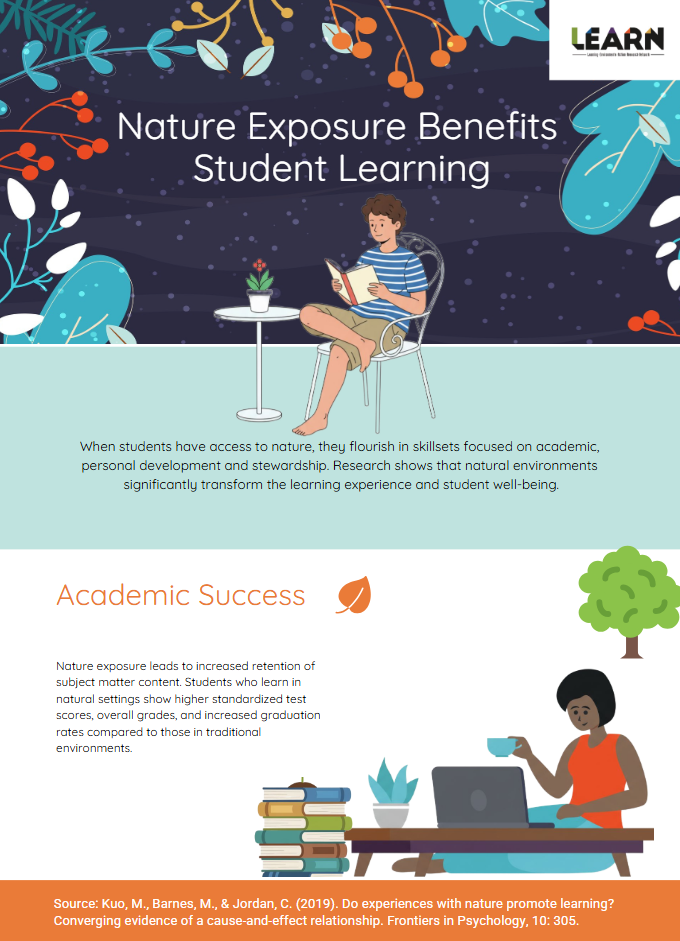
A growing body of research now demonstrates that experiences with nature meaningfully support learning, personal development, and environmental stewardship. While early claims outpaced evidence, the field has matured, with hundreds of studies establishing clear cause-and-effect relationships between nature-based experiences and positive outcomes. Research shows that nature-rich learning environments enhance academic performance—often outperforming traditional instruction—while also fostering skills such as perseverance, problem solving, critical thinking, leadership, teamwork, and resilience. In addition, extensive evidence links experiences in nature to the development of pro-environmental behaviors, largely through strengthening emotional connections to the natural world. Nature appears to promote learning by improving attention, reducing stress, increasing motivation and physical activity, and creating calmer, more cooperative, and developmentally supportive learning contexts. Taken together, the evidence underscores the importance of treating nature as a powerful educational resource, especially for students underserved by conventional approaches.
When students have access to nature, students flourish in skillsets focused on academic, personal development and stewardship by having: