Learning Environments Action Research Network (LEARN)
Follow Our Social:

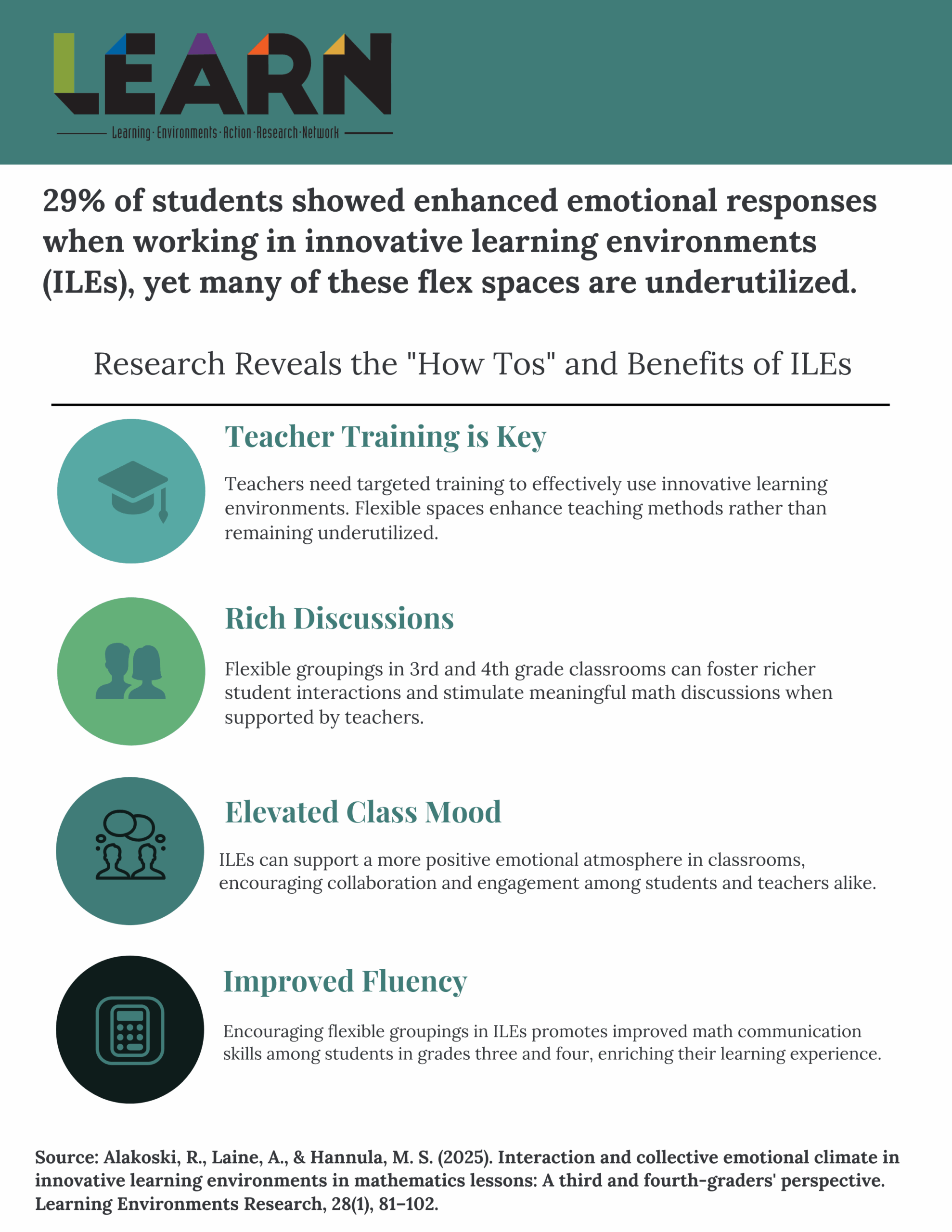
Source: Alakoski, R., Laine, A., & Hannula, M. S. (2025). Interaction and collective emotional climate in innovative learning environments in mathematics lessons: A third and fourth graders’ perspective. Learning Environments Research, 28(1), 81–102.
Criteria for Selection: The selection criteria included Finnish 3rd and 4th grade mathematics classrooms situated in innovative learning environments (ILEs) that utilized either fixed or flexible student grouping practices. Peer Reviewed Study.
LEARN Brief and Infographic Credits: Dr. Crystal Glover, Dr. Jeannie Haubert, Ashlea Sovetts, MFA
Overview:
This Finnish study examines the conditions in which innovative learning environments (ILEs) can support interaction and positive emotional climates in 3rd and 4th grade math classrooms. ILEs vary greatly from one to another, but either provide large open spaces, or include flexible classrooms that can be arranged in different ways to support the learning objective of a particular class. The researchers identified that even though ILEs provide options for different ways of grouping students, many teachers kept with traditional fixed grouping models. This allowed them to examine the difference of interactivity, math speech, and emotional classroom climate between fixed and flexible student grouping.
The researchers used an innovative methodology to assess differences between the two types of classes by having 446 third and fourth graders from 26 classrooms each draw a picture of an “ordinary mathematics’ lesson.'” The researchers then coded the drawings using several criteria: teacher interactivity, students’ interactivity, students’ and teachers’ speech content, and collective emotional climate. After the drawings were coded, the researchers used six Chi Square tests to examine the relationships between the criteria and the type of grouping (fixed or flexible).
The researchers observed a statistically positive result for flexible class groupings for 3rd and 4th grade students’ interactivity, students’ speech content, and students’ positive classroom environment. They did not find significant difference of teachers interactivity and math speech between the two groups. While these are promising results, the researchers caution that these same results might not be observed in older students.
Key Insights:
Action Step:
Explore some of the latest flexible furnishings here edgallery (not a sponsored link).