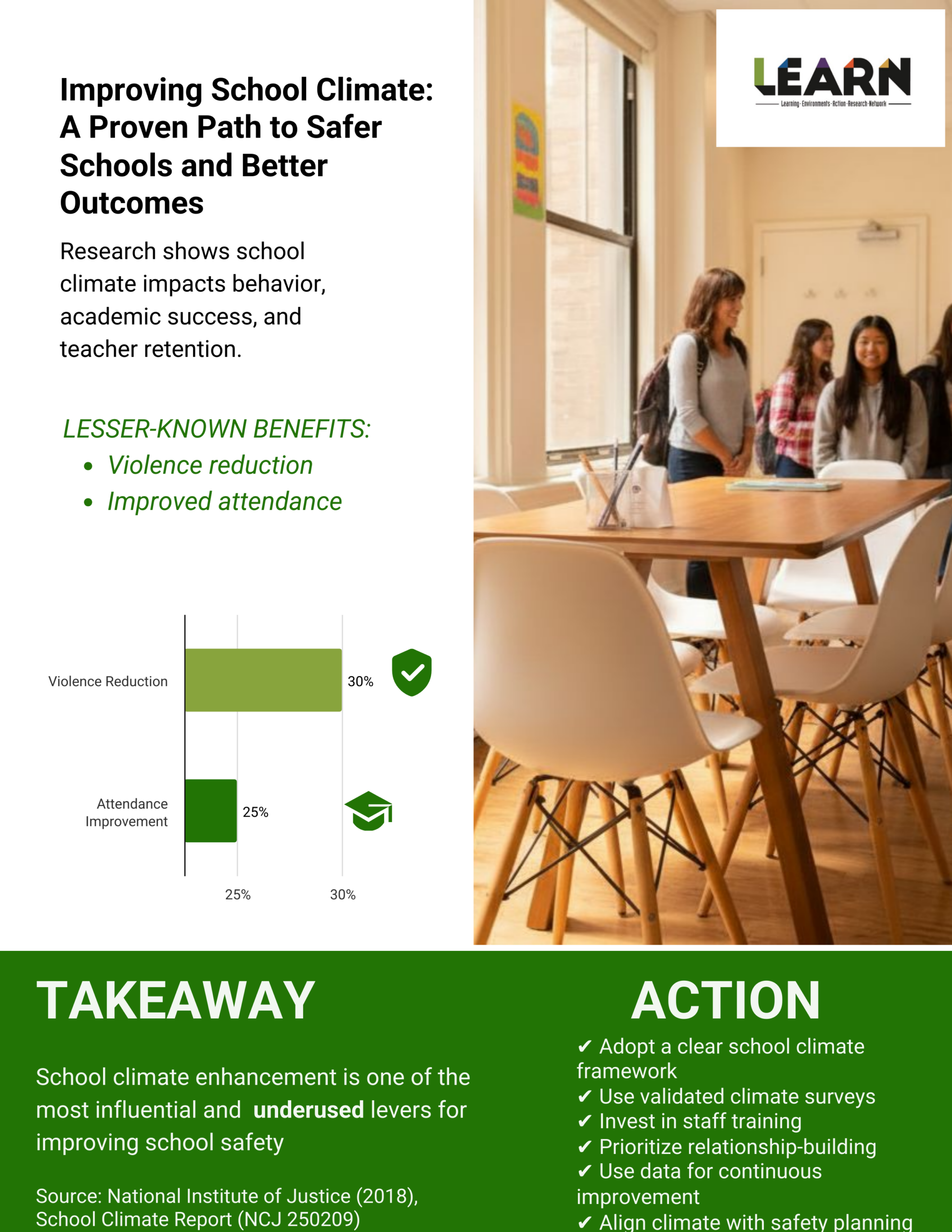
Source: National Institute of Justice (2018), School Climate Report (NCJ 250209)
LEARN Brief and Infographic Credit: Dr. Jeannie Haubert
Overview
The National Institute of Justice report “Creating and Sustaining a Positive and Communal School Climate” examines how school climate—defined broadly as the quality of relationships, safety, norms, and environment—affects student behavior and outcomes. It synthesizes research showing that schools with strong, positive climates experience lower levels of violence, bullying, and disorder, alongside better academic performance and student well-being.
The report also highlights that while school climate is widely recognized as important, it is inconsistently defined and measured, making it difficult to assess and improve systematically. It outlines key barriers—such as fragmented data, implementation challenges, and inequities—and concludes with recommendations for strengthening research, policy, and practice to build more cohesive, community-oriented school environments.
Key Insights
- School climate is a major lever for safety and outcomes
Positive, community-oriented environments reduce misconduct and improve both social and academic outcomes.
- Relationships are central—not just rules
Strong student–teacher relationships, fairness, and a sense of belonging are more predictive of success than punitive discipline alone.
- Measurement is a major weakness
There is no single agreed-upon definition or tool for assessing school climate, which limits consistency and accountability.
- Punitive approaches can backfire
Over-reliance on exclusionary discipline (suspensions, zero-tolerance) can undermine trust and worsen inequities.
- Equity matters
Students’ experiences of fairness and safety vary by race, background, and other factors, influencing outcomes and perceptions of legitimacy.
- Implementation is complex
Improving climate requires coordinated, whole-school efforts—not isolated programs.
Action Steps
1. Define and measure your “climate” clearly
- Choose a consistent framework (e.g., safety, relationships, engagement)
- Use regular surveys of students and staff to track progress
2. Prioritize relationships and belonging
- Train staff on relationship-building and culturally responsive practices
- Create structures for student voice and participation
3. Shift discipline toward restorative approaches
- Reduce reliance on suspensions/expulsions
- Implement restorative justice or conflict-resolution practices
4. Take a whole-organization approach
- Align policies, leadership, and daily practices around climate goals
- Avoid one-off programs—focus on sustained culture change
5. Address equity explicitly
- Disaggregate data by race, gender, etc.
- Identify and correct disparities in discipline and student experience
6. Invest in continuous improvement
- Treat climate like a long-term strategy
- Regularly review data, adapt interventions, and engage stakeholders
Full Report
https://www.ojp.gov/pdffiles1/nij/250209.pdf